The Protocol
On creatine, longevity culture, and the quiet architecture of manufactured consensus

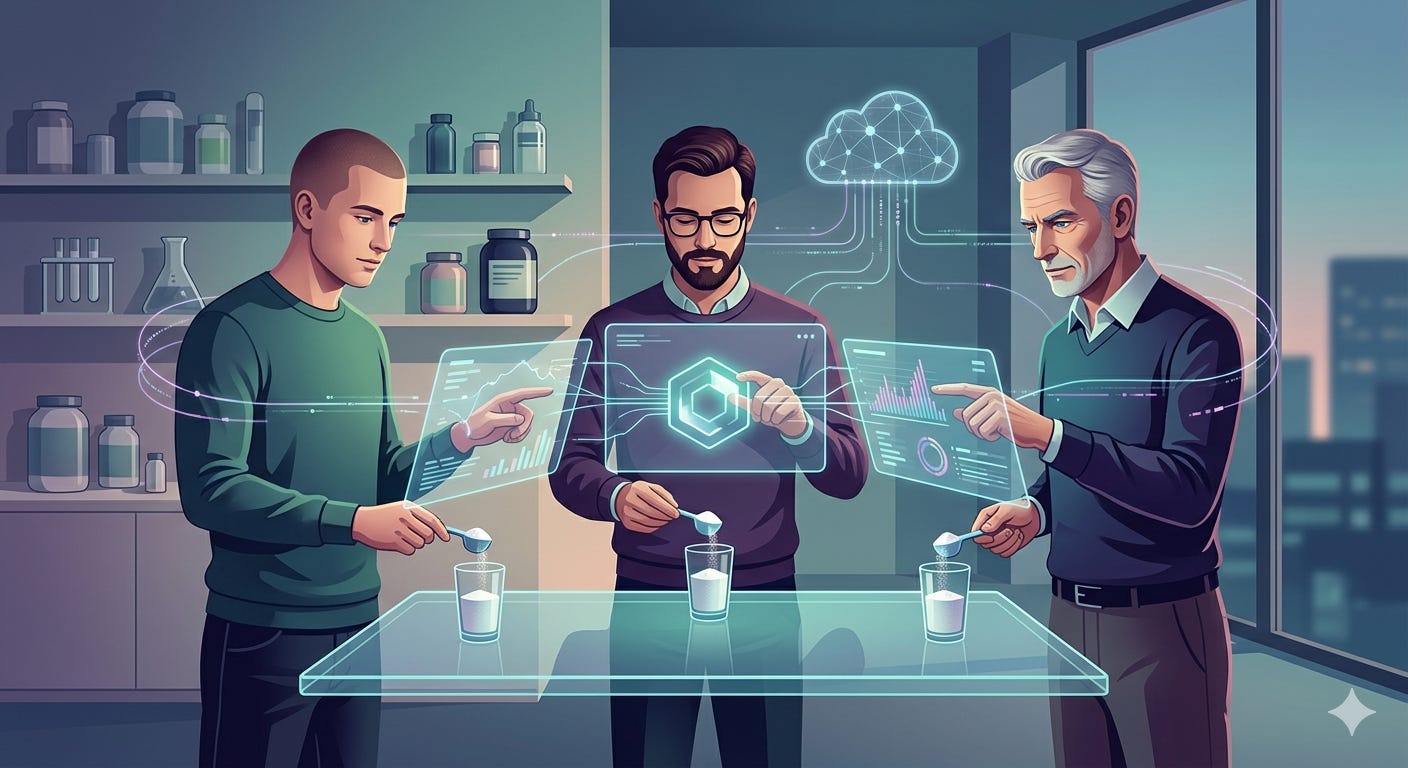
Last month I had dinner with three people I have known for years. Call them Marco, James, and David.
Marco is 41. Senior engineering manager at a fintech company. PhD in computer science, genuinely curious, the kind of person who treats trends as things to be dissected rather than adopted. James is 38. Product director at a SaaS startup, former academic researcher, the type who reads the methodology section before the abstract. David is 47. Data architect. Two decades in tech, someone who has watched enough hype cycles roll through to be largely inoculated against them.
Three different cities. Three different companies. Three people who had not shared a room in years.
Within twenty minutes of sitting down, all three were reciting the same script.
Five grams of creatine monohydrate every morning. Zone two cardio, four sessions a week. Protein at 1.6 grams per kilogram of body weight, minimum. Bloodwork every six months.
Not similar ideas. The same sentences. The same numbers. The same citations. The same inflection on the word evidence-based, deployed as a kind of verbal credential, proof that what follows is a rational conclusion rather than a lifestyle trend.
I put down my fork and just listened.
These are not impressionable people. Under normal circumstances, they would be the first to notice when someone is selling them something. And yet here they were, perfectly synchronized, speaking a dialect I had never heard before but immediately recognized as something much larger than the three of them.
I went home that night with one question: what, exactly, am I looking at?
The Vocabulary
Before getting into the mechanics, spend a moment on what this phenomenon looks like from outside it.
If you have friends in tech between 35 and 50, there is a good chance some of them have recently picked up a specific vocabulary: healthspan, VO2 max, zone two, longevity protocol, sarcopenia, mTOR, glucose variability, sleep architecture. These are not casual words. They come from sports science, geroscience, and clinical medicine. They are now in circulation at dinner tables and in Slack channels, used by people who, eighteen months ago, were not reading papers on mitochondrial efficiency.
The creatine specificity is what caught my attention. Not just creatine in general. Five grams of creatine monohydrate, unflavored, every morning regardless of whether I train. That exact sentence. That exact number. Across geographies, companies, people who have never met and never will.
This is information architecture. Understanding it means tracing the pipeline that produced it.
Layer One: The Credentialed Creators
The longevity content ecosystem is anchored by a small number of figures with genuine scientific credentials who built audiences by translating research into protocols.
Andrew Huberman is a Stanford neuroscientist whose Huberman Lab podcast reached the top of global charts. He is also on LinkedIn. His supplement recommendations are specific and short: Alpha-GPC, L-Tyrosine, creatine for power output, whey protein for recovery. The brevity reads as discipline rather than maximalism. He has also published content on creatine’s role in mood and motivation, pulling the frame well beyond muscle performance. That expansion is the key move: creatine stops being a gym supplement and becomes a cognitive optimization tool, a very different product for a very different buyer.
Peter Attia, trained at Stanford and Johns Hopkins, wrote Outlive, probably the most commercially successful longevity book of the past decade. His podcast, The Drive, goes deep into clinical literature, blood panels, pharmacology. He is also on LinkedIn. He and Huberman have appeared together repeatedly, cross-pollinating audiences and reinforcing each other’s authority.
These are not charlatans. The science they cite is largely real. The effect sizes they discuss are mostly honest. But they are the entry point of a funnel, whether they intend to be or not. That distinction matters less than most people assume.
Layer Two: The Amplification Machine
Once a credentialed figure endorses a protocol, the social media apparatus takes over. The content pattern is now almost formulaic: a person in their forties in a well-lit kitchen scooping powder into a smoothie while citing scientific studies; a clip of Huberman or Attia from a podcast; a sponsored post from an athlete holding a tub of creatine. Three formats, three audiences, one product, infinite loop.
Creatine demand spiked between 2021 and 2022, driven by pandemic home fitness and influencer marketing. By August 2025, search interest for “creatine monohydrate” was near record highs. The relationship between influencers and the category has since shifted: many creators are now launching their own creatine brands, collapsing the line between content and commerce into a single entity that is simultaneously media company, distribution channel, and product manufacturer.
The market numbers are clear. The creatine segment targeting cognition and healthy aging is growing at double digits annually. In the UK alone, the overall creatine market is projected to expand at 14.8% per year through 2035. This is a category repositioning, and it happened largely through content.
Layer Three: Peer Replication
This is the layer that never gets discussed. Once a critical mass of people within a social network adopts a behavior and a vocabulary, the behavior spreads through direct social contagion rather than media. Marco did not learn about creatine from Huberman directly. He heard it from a colleague who heard it from someone else. The original signal was upstream and invisible. What remained was the protocol, clean and portable, passing from person to person like source code.
This is how you get linguistic synchrony across continents. The content travels through media, gets compressed into shareable talking points, then replicates through social networks faster than any advertising campaign could manage. The medium disappears. The message persists. And the message sounds, increasingly, like independent thought.
And Then There Is AI
This is the part of the story that does not get enough attention.
The amplification pipeline I just described existed before large language models became consumer products. Something changed around 2023, when AI-powered recommendation systems and generative content tools became embedded in the platforms where this content lives.
The change is structural. AI recommendation systems on TikTok, YouTube, and Instagram are not simply surfacing content that people search for. They are building feedback loops that progressively narrow each user’s informational environment. Watch one Huberman clip and you are systematically more likely to see another, and another, and eventually the protocol-adjacent content that surrounds him. You do not choose the rabbit hole. The rabbit hole finds you.
Research published in peer-reviewed literature now documents this clearly. A 2025 paper in PMC found that AI-powered recommender systems on major social platforms frequently prioritize engagement over accuracy, and in health content specifically, they tend to reinforce the user’s existing preferences rather than expose them to correction or dissent. The same research noted that people rate AI-generated health content as slightly less accurate than human-generated content but are equally likely to share it. Accuracy perception and sharing intent have come apart. Style, novelty, and emotional resonance drive diffusion more than epistemic quality does.
A parallel development: AI tools are now being used to produce health content at scale. A 2025 NIH-published review described how generative AI fundamentally lowers the barriers to producing credible, tailored narratives. A single creator with a genuine credential and a small production team can now generate content volume that would have required a small media company five years ago. The credentialed anchor stays real. The surrounding ecosystem expands synthetically. From the consumer’s perspective, the signal-to-noise ratio looks consistent throughout.
The consensus is manufactured, but not deliberately. It is a structural property of systems optimized for engagement at scale.
Nobody decided that tech workers in their forties should all be taking five grams of creatine monohydrate every morning. The algorithm found that this message traveled furthest in this demographic and organized the information environment accordingly.
Worth sitting with that. The feeling of reaching an independent, evidence-based conclusion can be an artifact of the system rather than a property of the reasoning. Smart people are not exempt from this. In some ways they are more exposed to it, because the system has learned to present its nudges in the language that smart people find persuasive.
The Dissenting Voices
The mainstream press has been paying attention. The New York Times and Outside magazine have both scrutinized what they call “longevity culture,” questioning the commercial architecture underneath it as much as the science itself. The core critique is about what happens to nuanced scientific communication when it passes through a content machine optimized for engagement and a supplement industry growing at 14-15% annually.
NPR asked in late 2025 whether the evidence actually supports the full scope of the claims being made about creatine. The answer, as is usually the case when complex science gets compressed into short-form video: it depends, and the details matter more than the headline.
Huberman himself pushed back against media critics. The pushback is fair in some respects: his actual supplement list is short, and his exercise recommendations are measured. But it also illustrates the dynamic. The credentialed creator is not responsible for the full ecosystem their audience builds. That ecosystem has its own logic, its own commercial interests, its own amplification mechanisms that operate independently of the original source.
Is This a Cult?
I want to be careful with the word, because it is inflammatory and the phenomenon is more precise than the word implies.
But consider the structural components. There is an authority layer largely beyond criticism within the community: questioning Huberman’s protocol in certain circles generates the same social friction as questioning doctrine in a congregation. There is an in-group identity: five grams of creatine monohydrate every morning is a signal about who you are and how you think, not just a health decision. There is a commercial apparatus that benefits from normalized adoption of the protocol: supplement brands, CGM companies, longevity clinics, wearable tech companies, all sponsoring the content that created the norms.
The behaviors reinforce the identity. The identity reinforces the behaviors. The commercial apparatus profits from both.
My three friends at dinner are almost certainly healthier for the protocol than they were before it. The creatine works. The zone two cardio works. The protein targets are broadly aligned with the scientific literature. The individual interventions are not the problem.
The epistemology is the problem.
Three highly educated, independently minded people arrived at identical conclusions through an identical path without noticing that they did. “Evidence-based” has become a brand positioning rather than a method. The system found a way to make conformity feel like independent thought, and the AI layer is now making that system more precise, more personalized, and more invisible than it has ever been.
What This Actually Is
A genuinely useful set of ideas has been captured by a content and commercial ecosystem that optimizes for reach over nuance. An AI-powered amplification infrastructure has learned that this particular message, framed in this particular language, travels efficiently through this particular demographic. The infrastructure does not know or care whether the protocol is right for each individual. It knows the message produces engagement, and it serves it accordingly.
The result: a population of educated people ends up making decisions that are probably net positive for their health, but that they arrived at through a process they do not fully grasped, using reasoning they believe is independent but was partially constructed for them, speaking a vocabulary they think they chose but that was chosen for them.
This matters well beyond creatine. The cognitive pattern that gets you to five grams of creatine monohydrate every morning, without noticing that everyone around you is doing the exact same thing, is the same pattern that can carry other messages. Less benign ones, with the same efficiency and the same invisible architecture.
Smart people are not immune to manufactured consensus. They are just better at explaining it to themselves afterward.
There is a question worth asking around any shared habit or consensus: how did we get to it in the first place. And whether, if the answer had been different, the system would have gotten you there anyway.
I have to confess I fell into the creatine thing for the past 5mo and it actually has made a difference in muscle mass. The longevity culture though mostly has little to do with solid science. Don’t get me started on methylation aging clocks I worked on age dependent methylation for awhile and mouse models of skeletal muscle aging. Recent papers show that 50+ % of longevity is heritable and that’s not using genome wide analysis. So it’s likely exercise does help but this is all heathspan, not longevity.
The external architecture you've mapped is precise — and the AI layer making it more invisible is exactly right. The missing piece is the internal one: most people have no instrument for distinguishing a conclusion they reached from one that was built for them. Smart people aren't immune — they're just better at explaining it to themselves afterward.