Intelligence Over Hierarchy: Block's Bet and Its Blind Spots
Jack Dorsey's organizational vision is the most serious rethinking of corporate structure I've read in years. It's also missing two things that matter enormously.

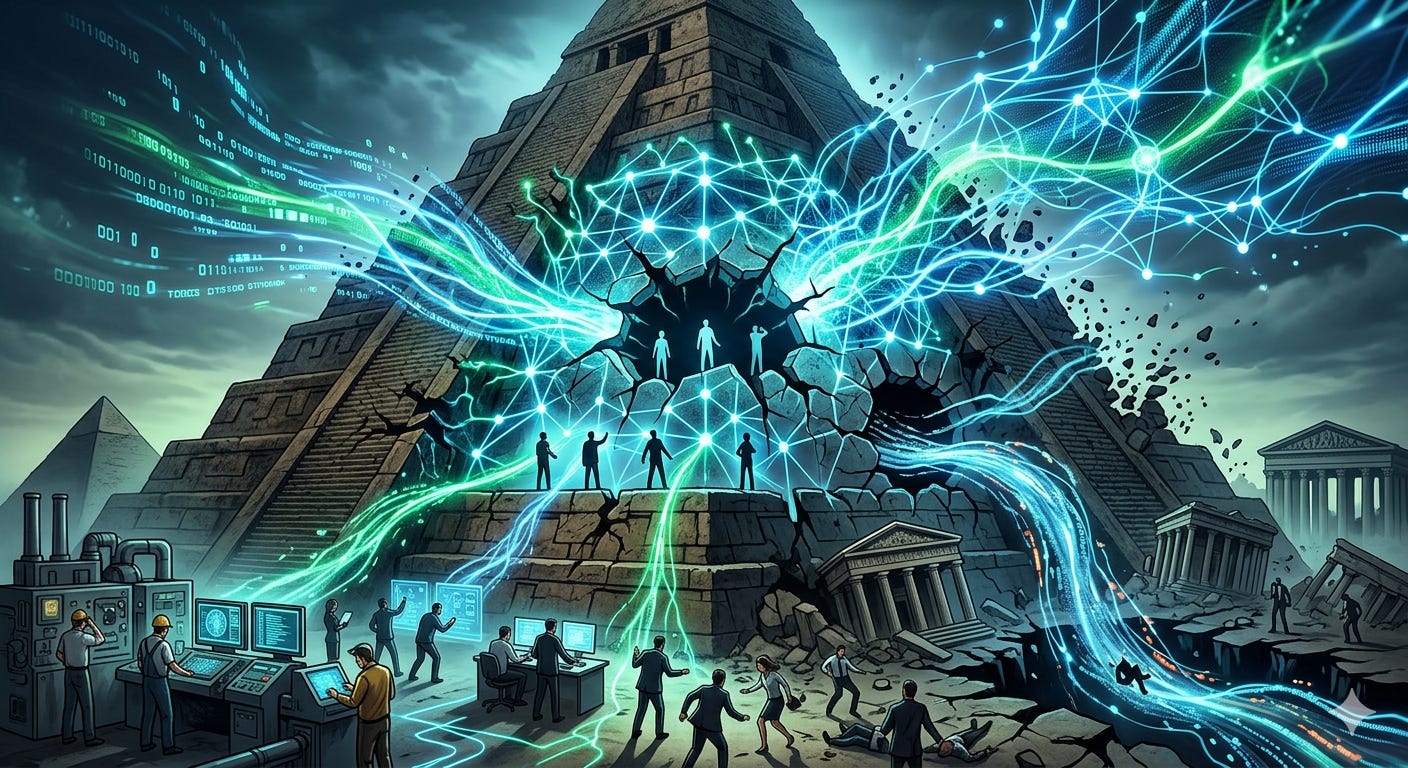
On March 31, Jack Dorsey and Sequoia’s Roelof Botha published something that reads less like a company blog post and more like a manifesto. From Hierarchy to Intelligence is Block’s attempt to answer a question most organizations actively avoid: “what does AI allow us to fundamentally stop doing?”
His answer: hierarchy itself. Or at least the information-routing function it has always served.
What Block Is Actually Arguing
The article opens with a history lesson worth following. Corporate hierarchy, the authors argue, was never about authority in the abstract. It was an information routing protocol built around a hard human constraint: one person can effectively coordinate somewhere between three and eight others. The Romans worked this out with the contubernium. The Prussians turned it into a professional staff corps. The railroads commercialized it. Frederick Taylor optimized it. Here we are, 150 years later, still running organizations through the same nested structure.
Dorsey’s thesis is that AI removes the constraint that made hierarchy necessary. If a “company world model” can continuously hold the context that managers used to carry and relay, information stops needing to travel up and down a chain of command. The hierarchy becomes overhead.
In Block’s proposed design, this translates to three roles: individual contributors who build and operate, Directly Responsible Individuals (DRIs) who own outcomes for defined periods, and player-coaches who develop people while still doing the work. No permanent middle management layer.
They also introduce a customer world model built from transaction data (Block sees both sides of millions of daily transactions through Cash App and Square) feeding an intelligence layer that composes solutions proactively, before a product manager has queued them on a roadmap.
For a remote-first, digital-native financial services company with deep proprietary data, it’s a coherent architecture.
Where the Argument Gets Complicated
The article itself acknowledges the most obvious objection. Spotify ran squads and tribes for years, then reverted to conventional management as it scaled. Zappos tried Holacracy, lost a significant chunk of its staff, and quietly moved on. Valve’s flat structure worked at a few hundred people and struggled beyond that.
Dorsey’s answer is that all those experiments failed because they lacked the technology to actually replace hierarchy’s coordination function. Squads and Holacracy were structural workarounds. AI is a functional replacement. That distinction matters.
But it raises a real question: how many organizations are actually positioned to try this?
“The hierarchy becomes overhead rather than structural necessity — but only if the intelligence layer actually works. That’s a very large ‘if’ for most companies.”
Scale. Block has around 7,000 employees. That’s meaningful, but it’s a different problem from running a 70,000-person organization. At that scale, coordination complexity grows faster than headcount. The question is whether AI can maintain coherent context across dozens of business lines, regulatory environments, and competing priorities simultaneously, without the accumulated judgment that experienced managers carry.
The physical world. Block is digital-native. Its outputs are transactions, software, data. A manufacturer’s most critical knowledge often lives in the hands of a technician who can hear a bearing failing before any sensor picks it up. That knowledge doesn’t become machine-readable because you deploy an AI coordination layer. The raw material for Block’s world model (code, decisions, messages, plans), bears little resemblance to what a chemical plant or logistics network actually runs on.
Labor law. The article was written from a US perspective, and it shows. The model Dorsey describes assumes employment flexibility that simply isn’t available in most of Europe. In Germany, France, or the Netherlands, reorganizations of this kind require works council consultation, negotiated transition plans, and timelines measured in years. That’s a structural constraint that makes Block’s model either irrelevant or a very long-term project for most European multinationals.
Two Things the Article Doesn’t Address
Culture. The piece doesn’t use the word once. That’s the tell.
Culture doesn’t just eat strategy for breakfast, it also chews up organizational design. Hierarchy survives not only because it routes information, but because it creates predictability, status, and identity. People know where they stand. They know who decides. They know how to advance. Strip the hierarchy without building something to replace that social architecture, and you don’t get a self-organizing intelligent system. You get a vacuum.
Block presumably has a strong internal culture, built deliberately over years by specific leaders. The article says nothing about how that culture was formed, what it looks like, or what a company without it would need to develop before attempting anything similar. Culture is the precondition for this kind of structural shift, not a downstream benefit of it.
Checks and balances in the intelligence layer. The article describes humans at the edge as the ones who “make the calls the model shouldn’t make on its own, especially ethical decisions, novel situations, and high-stakes moments where the cost of being wrong is existential.” Fair enough. But the design of human oversight in an AI-driven coordination system is more complex than a clause can capture.
Who audits the model’s priorities when they drift? How does a DRI challenge a recommendation from the world model without a formal escalation path? What happens when the intelligence layer optimizes for measurable transaction signals at the expense of things that don’t show up in the data? Ethan Mollick has written about management as a kind of AI superpower where the manager is amplifying the system rather than being replaced by it. Block’s model needs a version of that built in, and the architecture for it isn’t visible in the article.
These aren’t hypothetical concerns. Every organization that has tried to make consequential decisions at scale with algorithmic systems has run into them.
Hierarchy Isn’t the Disease
Hierarchy is not inherently broken. The Roman legion was hierarchical and also one of the most adaptive military machines in history. Most corporate hierarchies accumulate layers over time; information gets filtered as it moves through them, and the structure becomes rigid. That’s the actual dysfunction.
Dorsey’s sharpest claim is this: hierarchy’s core function information routing and coordination can now be handled by a system that is faster, more complete, and less subject to human filtering bias. That’s worth taking seriously.
Whether Block can execute this at scale, across its full operating complexity, is something we’ll find out over the next few years. I’ll be watching closely.